The Incite to Write Method
Does your child stare at the page, write three sentences,
and say "I can't
think
of anything else?"
You’re not alone. But this is not a writing problem. It’s a thinking problem. It’s the thinking component of writing that makes it difficult.
Spelling, grammar, and sentence structure are essentials of writing. But even a child who’s mastered every mechanic can still stare at a blank page.
That’s because what makes writing possible is the thinking that comes first: coming up with an idea, then knowing what to do with it once you have one. Skip that part, and mechanics alone won’t get a child past “I don’t know what to write.” Master it, and everything else has something to work with.
Incite to Write is built on a thinking process with documented results — including an average 97% success rate across five states in federally funded programs (see below).


Writing starts with thinking. And the best place to start with thinking is, “I don’t know!” It’s the natural starting place.
“I don’t know” is not a problem to fix, or a sign that your child is stuck. It’s actually the doorway, not the dead end. It signals openness to something new, openness to discovery. Ideas can’t come to a mind that’s already decided it knows everything.
For centuries, education has praised “I know.” But idea generation starts with an open mind that gives permission for your child’s innate curiosity to take over.
Once “I don’t know” stops feeling like failure and starts feeling like the opening it truly is, the mind is free to do some interesting thinking. That thinking process is what the Incite to Write Method is built on.
And because your child is learning thinking skills, you won’t have to worry about AI doing their thinking for them. They can do it for themselves, and they wouldn’t have it any other way. AI can be a tool, but their expression is all their own.

The Incite to Write Method

From curiosity, comes questions. When we don’t know, we start asking questions, and those questions generate more questions. This is how your child walks through the doorway and begins to explore their mind and their capacity for original thinking.
At the heart of the Incite to Write Method is the Incite to Write Inquiry Process, the foundation that makes everything else possible. Students learn to ask their own questions and follow them wherever they lead. Not questions they are handed. Questions that are entirely their own.
One question leads to an answer. That answer sparks another question. Before long, a child who had “nothing to write” has a trail of their own thinking to follow — and something they actually want to say.
This is what Module 1: Wake Up Your Mind! How to Build & Write Paragraphs teaches. Your child learns how to think, question, and generate ideas — the skill every other kind of writing depends on. Thinking skills are fun to learn and fun to teach. Many of the strategies are interactive and oral, and work well with one child or a full classroom.
Module 2 teaches the basics of Grammar, Module 3 Narrative Writing, and Module 4 Expository & Persuasive Writing. All four modules include Strategies and Worksheets and work at any grade level 3-8.
Who It’s For
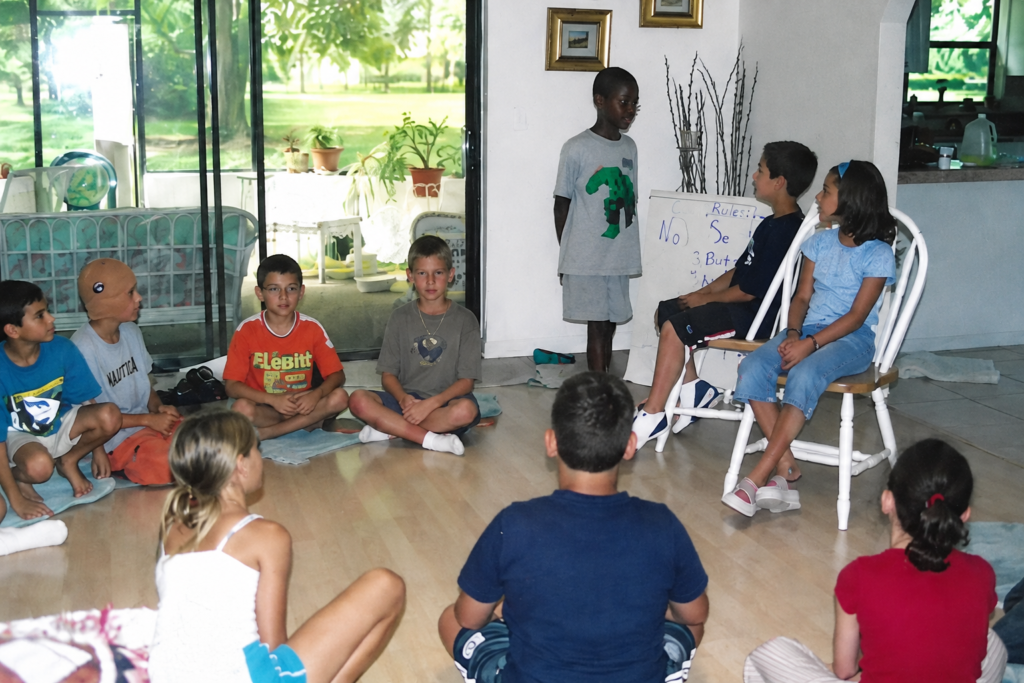
Parents who want a new way to work with reluctant writers that is easy and fun for them to use, and that can be used with multiple kids of different levels at the same time. Incite to Write was built as a fun, interactive, hands-on curriculum to get kids out of their seats and enjoying using their minds.
It’s for kids who need a sequence of tools that make sense to them, that they can do right from the start, and that give them confidence to keep going. No more freezing, no more “I hate writing”. Starting from wherever they are is just fine.

Why It’s Different
- Thinking First
Many writing curricula lead with grammar and written output. But research points the other way: the biggest obstacle for most students isn’t mechanics — it’s coming up with an idea, and then expanding on it once they have one. Incite to Write treats “how do I go from blank to something” as a teachable, sequenced skill.
- Oral Interaction
Because the process builds thinking skills, kids don’t even need to pick up a pencil until the 8th strategy. Critical and creative thinking skills can be practiced orally first, and they are fun to do with the whole family.
- Any Grade Level
Incite to Write does not teach to one grade level, so there is no concern over the question of “Is my child at the right grade level?” The skills for good writing are the same, whether you’re in 3rd grade or college. Each child comes in at their own level. The strategies are designed to be used again and again to help students grow in their writing mastery.
- Learn Together
This also means that if you are homeschooling children at different grade levels, they can all do the same strategies. It works the same for a 3rd grader and an 8th grader — so they can build writing skills together, each at their own pace, using the same sequence.
The evidence
-
97%
Success Rate
Average Success rate in helping struggling students meet their Language Art Goals
-
1000+
Kids
Used with thousands of students in Title I programs for 6 years

States
Used across five states in federally funded programs
-
Tier 1
ESSA
Meets ESSA (Every Student Succeeds Act) Tier 1 evidence standard
Incite to Write’s strategies meet ESSA (Every Student Succeeds Act) Tier 1 evidence standard — the same bar required for federal education grant funding. Incite to Write was used across five states in Title I programs for 6 years, with an average 97% success rate in helping struggling students meet their Language Arts goals. All strategies and worksheets align with Common Core standards for Writing, Language Usage, and Speaking & Listening, with the corresponding standard noted on every strategy and worksheet. This is useful if you’re a teacher or tracking standards for your state’s homeschool requirements.